Meat Storage Guide: How to Refrigerate, Freeze, Thaw, and Refreeze Meat Safely
Proper meat storage is one of the foundations of safe home cooking. A good cut of beef, pork, chicken, or other meat can lose quality quickly when stored at the wrong temperature, left unrefrigerated for too long, or exposed to excess air in the freezer. More importantly, poor storage can allow harmful bacteria to multiply before cooking even begins.
The basic rules are simple: keep refrigerated meat cold, freeze meat you will not use soon, prevent raw juices from contaminating other foods, and thaw frozen meat using a safe method. The details matter because refrigeration, freezing, packaging, and thawing affect both food safety and eating quality.
This guide explains how to store meat correctly in the refrigerator and freezer, how long different types of meat can be kept, why freezer burn happens, how freezing affects texture, when thawed meat can be safely refrozen, and what to do after a power outage. It also explains the food science behind these practices so that the recommendations are easier to understand and apply.
Why Proper Meat Storage Matters
Fresh meat is highly perishable because it contains abundant water and nutrients that can support microbial growth. Refrigeration slows the growth of many bacteria, while freezing stops the growth of microorganisms during frozen storage. Neither method makes contaminated meat sterile, however. Microorganisms that survive freezing can become active again after thawing if the meat is held under conditions that allow them to multiply.[1]
This distinction is important. Freezing preserves safety; it does not reliably kill all bacteria. A package of meat that was safe before freezing can remain safe when kept continuously at 0°F (-18°C) or below, but freezing does not reverse unsafe handling that occurred before it entered the freezer.[1]
Temperature therefore has two separate roles:
-
Refrigeration slows bacterial growth and keeps fresh meat within a limited storage period.
-
Freezing stops microbial growth and allows much longer storage, although quality gradually declines.
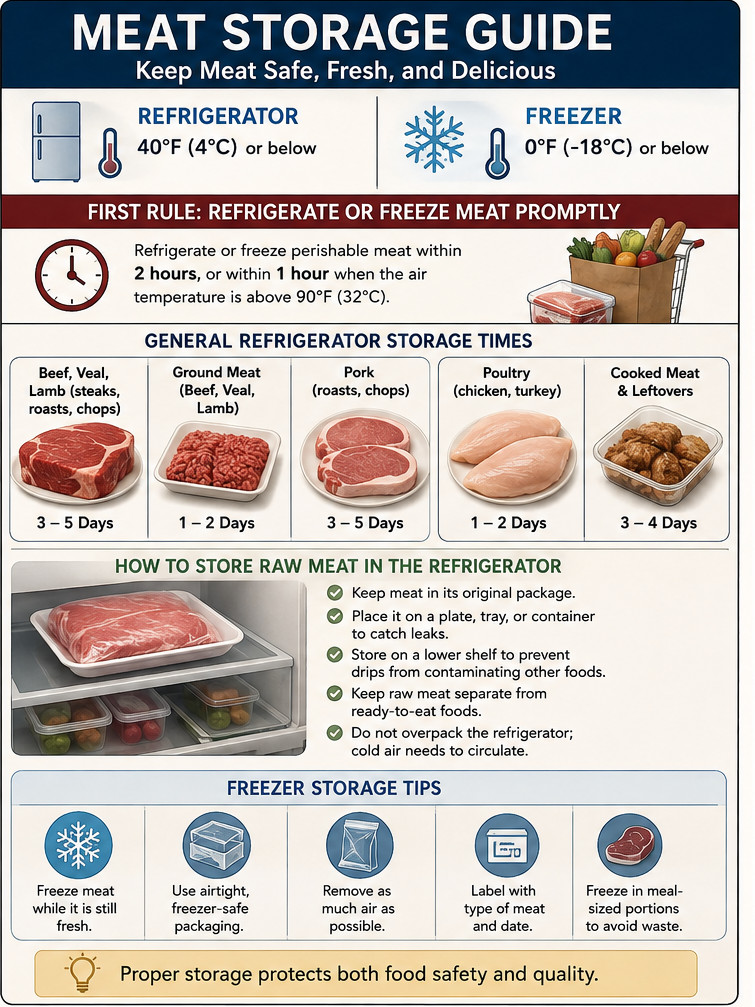
The recommended refrigerator temperature is 40°F (4°C) or below, while the freezer should be maintained at 0°F (-18°C) or below.[2][3] Because refrigerator controls do not always show the actual internal temperature accurately, an appliance thermometer is a useful way to monitor both environments.[3]
The First Rule: Refrigerate or Freeze Meat Promptly
Meat should not remain at room temperature unnecessarily. Perishable foods should generally be refrigerated or frozen within 2 hours, or within 1 hour when the air temperature is above 90°F (32°C).[2][4]
This recommendation exists because bacterial populations can increase rapidly when food is held at temperatures that support growth. Refrigeration slows this process, but the safest approach is to reduce the time meat spends outside temperature control in the first place.[3]
After shopping, unpack groceries promptly and refrigerate or freeze meat rather than leaving it on the counter while preparing other foods. If the trip home is long, especially in hot weather, an insulated bag or cooler can help keep perishable foods cold.
For cooked meat and leftovers, the same principle applies. Refrigerate them promptly rather than allowing a large dish to sit on the counter until it reaches room temperature. Dividing large quantities into smaller or shallow containers can help them cool more efficiently in the refrigerator.[3]
How to Store Raw Meat in the Refrigerator
Raw meat should be stored in a way that controls both temperature and cross-contamination.
Keep it in its original unopened package if you plan to use it within the recommended refrigerated storage period. Place the package on a plate, tray, or other container that can catch leaks, and store it where raw juices cannot drip onto ready-to-eat foods.[5]
A lower refrigerator shelf is often a practical location for raw meat because it reduces the risk of drips contaminating foods below it. Ready-to-eat foods, cooked meat, and foods that will not receive further cooking should be protected from contact with raw meat and its juices.
Avoid overpacking the refrigerator. Cold air needs room to circulate, and excessive crowding can make it harder for the appliance to maintain consistent temperatures around stored food.[2]
General Refrigerator Storage Times
The exact storage period depends on the type of meat and whether it is raw or cooked. USDA guidance generally recommends shorter refrigerated storage for ground meat and poultry than for larger whole-muscle cuts.[6][7]
As a practical guide:These time frames assume the meat has been handled safely and kept continuously refrigerated. If you do not expect to use the meat within the recommended period, freezing it sooner is usually the better option.[6][7]

The Food Science of Freezing Meat
Freezing changes the physical state of water in meat. As the temperature falls, water begins forming ice crystals. The size and distribution of those crystals can affect the structure of the meat.
When freezing occurs slowly, larger ice crystals have more time to develop. These crystals can damage cell structures, contributing to greater moisture loss when the meat later thaws. Faster freezing generally produces smaller ice crystals and can better preserve texture and juiciness.[1]
This does not mean that home cooks need specialized industrial freezing equipment. The practical goal is simply to freeze meat efficiently. Divide large quantities into smaller portions, avoid unnecessarily thick packages, and arrange newly frozen packages so cold air can circulate around them before stacking them tightly together.[1]
Freezing also does not significantly destroy the nutritional value of meat. The larger concern during long storage is usually quality: moisture loss, oxidation, texture changes, and flavor deterioration can gradually occur even when the meat remains frozen and safe.[1]
Freeze Meat While It Is Still Fresh
Freezing extends storage time, but it does not improve meat that is already deteriorating. Meat generally produces better results after thawing when it is frozen while still fresh rather than at the end of its refrigerated storage life.[1]
If you buy more meat than you expect to use soon, portioning and freezing it promptly can reduce both food waste and quality loss.
How to Package Meat for Freezing
Proper packaging is one of the most effective ways to preserve frozen meat quality.
It is safe to freeze meat or poultry in its original packaging. However, thin retail wrapping may allow air to reach the food over extended storage, increasing the risk of dehydration and freezer burn. For longer storage, overwrapping the original package with freezer-safe material or transferring the meat to an airtight freezer bag or container can provide better protection.[1][7]
The main goal is to limit exposure to air.
Before sealing a freezer bag, remove as much excess air as practical without crushing delicate food. Vacuum-sealed meat can also be frozen in its unopened packaging when the package remains intact.[1]
For convenience and food safety, consider dividing large packages into meal-sized portions before freezing. This avoids repeatedly thawing more meat than you need.
Label Everything
A simple label can prevent unnecessary waste. Write down:
-
the type and cut of meat
-
the date frozen
-
the number of portions, if useful
Freezer storage recommendations are primarily about maintaining quality rather than determining whether continuously frozen food is safe. Labeling makes it easier to use older packages first and maintain better rotation.[1]
Freezer Burn: What It Is and Whether the Meat Is Safe
Freezer burn is one of the most common quality problems associated with frozen meat. It occurs when the surface loses moisture because of exposure to air. The affected areas may look dry, pale, grayish, or leathery.[1][8]
Freezer burn does not automatically make meat unsafe. The affected portions may simply have poor texture and flavor and can often be trimmed away. Meat with severe freezer burn may be safe but unpleasant enough in quality that discarding it becomes the practical choice.[1][8]
The best prevention is proper packaging. Airtight wrapping, minimal air exposure, and a freezer maintained at 0°F (-18°C) or below all help protect quality.[1]
Freezer burn should also be distinguished from spoilage. A dry, discolored patch caused by freezer burn is different from meat that developed signs of spoilage before freezing.
Why Frozen Meat Changes Color
Color changes can occur during freezer storage and do not automatically mean that meat is unsafe.
Frozen meat may become darker or paler depending on the type of meat, oxygen exposure, packaging, freezer burn, and storage duration. USDA guidance notes that color changes during frozen storage can occur without necessarily affecting food safety.[8]
Because color alone is not a reliable safety test, it should be evaluated alongside storage history and handling conditions. If meat has been kept continuously frozen and properly handled, some color changes may simply reflect quality changes.
This is one reason appearance and odor should not be used as the only test of food safety. Some dangerous microorganisms do not produce obvious visual or odor changes.[3]
How Long Can Meat Stay Frozen?
Meat kept continuously at 0°F (-18°C) or below remains safe indefinitely, but quality gradually declines over time.[1]
Recommended freezer storage times are therefore best understood as quality guidelines rather than strict safety deadlines.
For the best quality, USDA guidance generally recommends the following ranges:[6][7]
Storage quality depends on packaging, freezer temperature stability, fat content, and how often the package is exposed to temperature fluctuations.
Fatty meats may develop rancid flavors more quickly than lean cuts during prolonged storage because fats can undergo oxidative deterioration over time. Good packaging and stable freezer temperatures help reduce this problem.

Safe Ways to Thaw Meat
There are three recommended methods for thawing meat safely:
-
In the refrigerator
-
In cold water
-
In the microwave
Meat should not be thawed on the kitchen counter or left at room temperature for extended periods.[1][3]
1. Thawing in the Refrigerator
Refrigerator thawing is generally the easiest method to manage because the meat remains under refrigeration throughout the process.
Place the meat on a tray or in a container to catch leaks. Allow sufficient time, especially for large cuts. Small packages may thaw overnight, while large items can require a day or longer.[1]
An important advantage is that meat thawed in the refrigerator can generally be safely refrozen without cooking, although repeated freezing and thawing may reduce quality because of additional moisture loss.[9]
2. Thawing in Cold Water
Cold-water thawing is faster but requires more attention.
Keep the meat in a leak-proof package and immerse it in cold water. Change the water every 30 minutes so it remains cold. After thawing, cook the meat immediately.[1][3]
The packaging matters because leaking can expose the meat to contamination and allow the product to absorb water, which may affect texture.
3. Thawing in the Microwave
Microwave thawing is useful when meat needs to be cooked soon, but uneven heating can cause some areas to become warm or begin cooking before other sections are fully thawed.
For this reason, meat thawed in a microwave should be cooked immediately after thawing.[1][3]

Can You Refreeze Thawed Meat?
Yes, but the answer depends on how the meat was thawed and how it was handled afterward.
If raw meat or poultry was thawed in the refrigerator, it can generally be safely refrozen without cooking. Some quality loss may occur because moisture is lost during thawing and refreezing.[1][9]
Meat thawed using cold water or a microwave should generally be cooked before being frozen again because these methods can bring portions of the food into warmer conditions where microbial growth may become a concern.[1][3]
Previously frozen raw meat can also be cooked and then frozen again as a cooked dish, provided it was handled safely throughout the process.[1][9]
The key principle is simple: refreezing is primarily a quality question when the food remained under safe temperature control; it becomes a safety problem when the meat spent too long at unsafe temperatures.
Do Not Rely on Smell Alone
A common mistake is assuming that meat is safe simply because it smells normal.
Odor can help identify obvious spoilage, but it cannot reliably detect all harmful microorganisms. Some pathogens can be present without producing a strong smell, visible mold, or dramatic color changes.[3]
For this reason, the most useful information is the meat's temperature and time history:
-
How long was it refrigerated?
-
Was it left at room temperature?
-
Did the refrigerator stay at or below 40°F (4°C)?
-
Did the freezer remain at 0°F (-18°C) or below?
-
How was the meat thawed?
When that history is unknown, appearance alone cannot provide certainty.
How to Store Cooked Meat and Leftovers
Cooked meat should be refrigerated promptly, ideally in shallow containers that allow it to cool efficiently.[3]
Store cooked meat separately from raw meat and raw juices. Use clean containers and clean utensils when transferring leftovers.
Most cooked meat and poultry leftovers should be used within 3–4 days when refrigerated properly.[7]
If you will not use them within that period, freeze them while they are still at good quality.
When reheating leftovers, proper reheating is important, but safe storage before reheating matters just as much. Reheating does not reliably correct every food safety problem created by extended time at unsafe temperatures.
Preventing Cross-Contamination During Storage
Cross-contamination can occur when bacteria from raw meat or its juices spread to foods that will not receive further cooking.
Keep raw meat contained and separated from:
-
cooked foods
-
salads and produce
-
ready-to-eat foods
-
leftovers
Use a plate or storage container underneath thawing meat to catch drips. Clean refrigerator shelves and surfaces promptly if raw juices spill.[2][5]
Do not place cooked meat back on a plate or tray that previously held raw meat unless it has been washed thoroughly.
The same principle applies to marinades. A marinade that contacted raw meat should not be used directly on cooked food unless it has been handled in a way that makes it safe, such as boiling when appropriate.[5]
What to Do During a Power Outage
A power outage can create uncertainty because safety depends on how warm the food became and for how long.
Keep refrigerator and freezer doors closed as much as possible. A full freezer generally stays cold longer than a partially filled one, while a refrigerator can warm more quickly once the door is repeatedly opened.[3][10]
After power is restored:
-
Frozen food that still contains ice crystals or remains at 40°F (4°C) or below can generally be cooked or safely refrozen.[3][11]
-
Perishable food that has been above 40°F (4°C) for too long should be discarded according to applicable food safety guidance.[10][11]
-
Never rely solely on smell, appearance, or taste to determine whether food exposed to unsafe temperatures is safe.[3][11]
During an outage, avoid opening the freezer repeatedly to inspect individual packages. Keeping the door closed preserves cold temperatures more effectively.
Common Problems & Solutions
The meat was left out overnight. Can it be refrigerated and saved?
Generally, no. Refrigeration does not reverse the bacterial growth that may have occurred while the meat was held at room temperature. Perishable meat should not remain outside refrigeration for more than 2 hours, or more than 1 hour when temperatures exceed 90°F (32°C).[2][4]
My frozen meat has ice crystals inside the package. Is it bad?
Not necessarily. Ice crystals can develop because of temperature fluctuations or moisture movement. They may indicate some quality loss, but safety depends more on whether the meat remained under safe frozen conditions.
The meat has freezer burn. Should I throw it away?
Freezer burn is primarily a quality problem. Lightly affected areas can often be trimmed away. Severely affected meat may be too dry or bland to be enjoyable, but freezer burn alone does not automatically make properly frozen meat unsafe.[1][8]
Can I refreeze meat after it has thawed?
If it was thawed in the refrigerator and kept properly refrigerated, it can generally be safely refrozen, although quality may decline. Meat thawed in cold water or a microwave should be cooked before refreezing.[1][9]
Why does meat sometimes release so much liquid after thawing?
This is often called purge or drip loss. Freezing can damage cell structures, particularly when larger ice crystals form. During thawing, some water and dissolved proteins can escape from the tissue instead of remaining inside it. Faster freezing and proper packaging can help preserve quality.[1]
Can I wash raw meat before storing or freezing it?
Washing raw meat is generally unnecessary and can spread bacteria through splashing onto sinks, counters, and nearby foods. Safe storage, preventing cross-contamination, and proper cooking are more effective food safety practices.[5]
Is vacuum-sealed meat always safe indefinitely in the refrigerator?
No. Vacuum packaging can slow some forms of quality deterioration, but it does not eliminate the need for proper refrigeration or make meat safe beyond appropriate storage guidance. Temperature and handling remain essential.
My meat looks darker after freezing. Is it spoiled?
Not necessarily. Frozen meat can become darker or change color because of oxygen exposure, storage conditions, or freezer burn. Color changes alone do not determine safety.[8]
Final Thoughts
Safe meat storage is not complicated, but it depends on controlling a few critical variables: temperature, time, packaging, and separation.
Keep fresh meat at 40°F (4°C) or below, and freeze meat at 0°F (-18°C) or below when it will not be used soon. Freeze meat while it is still fresh, package it to limit exposure to air, and thaw it in the refrigerator, cold water, or a microwave rather than on the counter.[1][2][3]
Understanding the food science also makes these practices easier to remember. Refrigeration slows microbial growth. Freezing stops microbial growth but does not sterilize food. Ice crystal formation can influence texture and moisture loss. Packaging protects meat from dehydration and oxidation. And once meat has spent too long at unsafe temperatures, freezing or reheating cannot simply restore its original safety.
With proper temperature control and handling, meat can remain both safe and high in quality for far longer, while better storage habits can also reduce unnecessary food waste.
References
[1] USDA FSIS — Freezing and Food Safety
[2] FDA — How to Cut Food Waste and Maintain Food Safety
[3] FDA — Refrigerator Thermometers: Cold Facts About Food Safety
[5] FDA — Meat, Poultry & Seafood Food Safety
[6] USDA FSIS — Chicken From Farm to Table
[7] USDA FSIS — Freezing and Food Safety: Storage Guidance
[8] USDA FSIS — The Color of Meat and Poultry
[9] USDA FSIS — Can Meat or Poultry Be Safely Thawed and Then Refrozen?
[10] FDA — Are You Storing Food Safely?
[11] USDA FSIS — May I Refreeze Food That Thawed or Partially Thawed?
FAQ
Most cooked meat and poultry leftovers should be refrigerated promptly and used within 3–4 days. For longer storage, they can be frozen. USDA guidance notes that frozen foods remain safe indefinitely when continuously kept at appropriate freezer temperatures, although quality can gradually decline.
Meat kept continuously frozen at 0°F (-18°C) or below remains safe for much longer storage, and recommended freezer times mainly relate to quality rather than safety. However, freezer burn, dehydration, oxidation, and flavor deterioration can still affect the final product. Proper airtight packaging helps reduce these quality changes.
If you do not expect to cook the meat within the recommended refrigerator storage period, freezing it before that period ends is generally the best option for extending its storage life. Freezing does not improve meat quality, so packaging it well and freezing it promptly usually produces better results after thawing.

About KIRA
KIRA is a home baker, a seasoned enthusiast of borderless casual dining, and a writer specializing in international cuisine. She has many years of practical experience in making various international dishes, controlling the resting time of sauces and fillings, and blending unique seasonings from around the world.
Each article revolves around real-world food preparation challenges: which exotic side dishes are prone to becoming watery and spoiling, which fillings should be sealed separately, and how baking time affects the texture and flavor of baked goods.


